


Ebola outbreak in the Democratic Republic of the Congo (DRC)
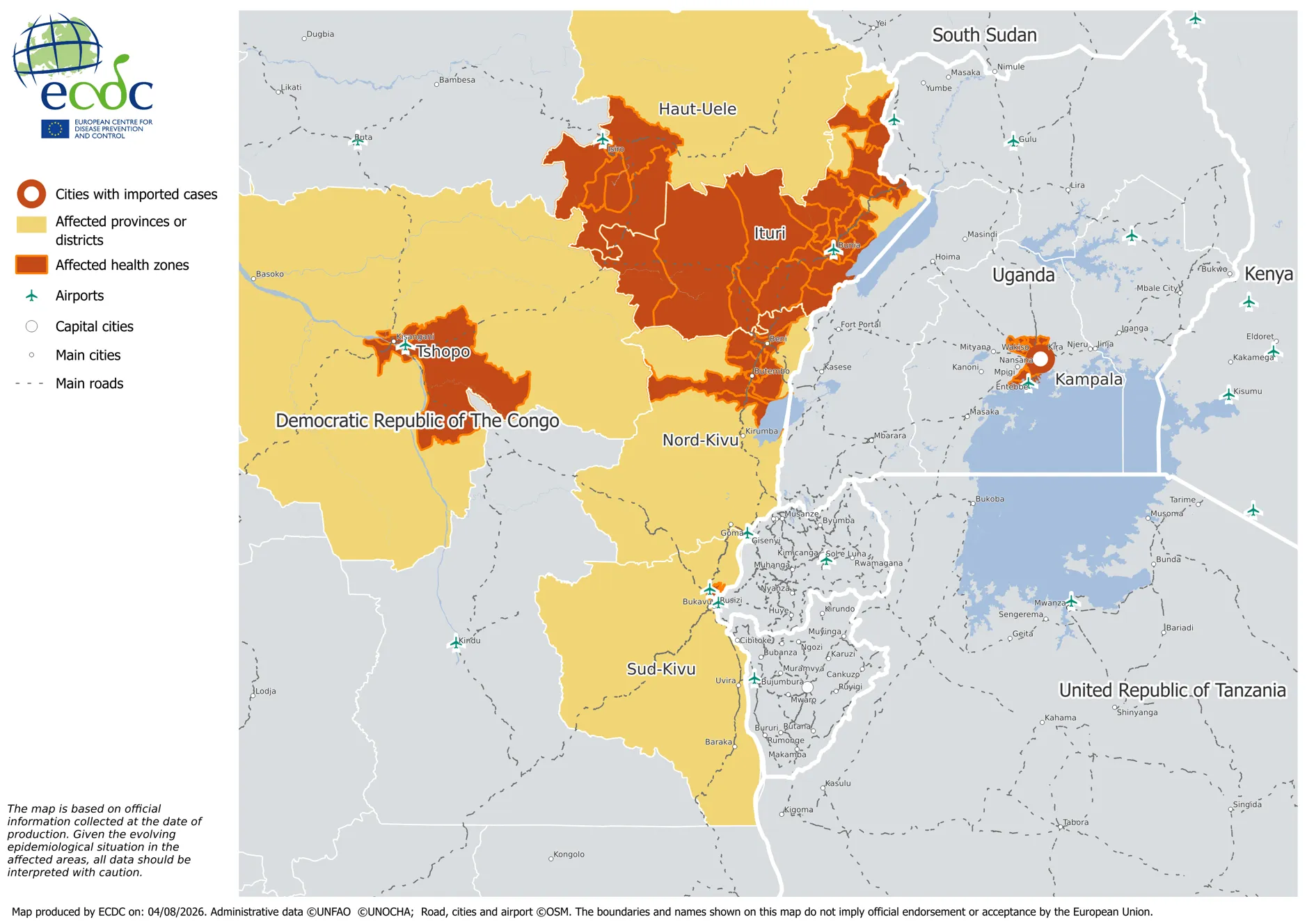
Since the declaration of a Public Health Emergency of International Concern (PHEIC) by the World Health Organization (WHO) on 17 May 2026, the Ebola disease outbreak caused by Bundibugyo virus in the Democratic Republic of the Congo (DRC) has intensified substantially. It is now the largest Ebola outbreak ever recorded in the DRC, with sustained transmission across five provinces: Ituri, North Kivu, South Kivu, Haut-Uélé and Tshopo. As of 30 July 2026, WHO reported 3,605 confirmed cases, including 1,587 deaths. The outbreak continues to intensify, with increasing case numbers, ongoing geographical spread, and high mortality.
The outbreak in Uganda was linked epidemiologically to transmission originating in the DRC. Uganda reported 20 confirmed cases and two deaths during the outbreak. No new cases were reported after 21 June 2026, and on 28 July 2026, Uganda declared the outbreak over following completion of the necessary monitoring period without evidence of ongoing local transmission. However, WHO has emphasised that the risk of further imported cases in Uganda remains high, because of ongoing transmission in neighbouring DRC.
Neighbouring countries remain at high risk of further spread due to frequent cross-border movement, trade links, population displacement, insecurity, and humanitarian challenges in affected areas. WHO continues to support preparedness and response activities across the region, including enhanced surveillance, contact tracing, clinical management, community engagement and cross-border coordination.
Areas in the Democratic Republic of the Congo and Uganda affected by the ongoing Ebola disease outbreak
Source: ECDC
The previous international experience of Ebola Zaire outbreaks has informed established preparedness and response frameworks in Ireland. However, this outbreak involves the Bundibugyo virus, for which no licensed vaccines or specific treatments currently exist, presenting additional challenges for response efforts.
Ireland continues to engage with the WHO and European Centre for Disease Prevention and Control (ECDC) to inform ongoing risk assessments.
ECDC has assessed the risk to Europe as very low. The likelihood of infection remains very low for people living in the EU/EEA, and low even for those travelling to the affected regions, due in part to the limited probability of importation and onward transmission. The risk to Ireland is very low.
Preparedness and Response Capacity
Ireland has prior experience managing Ebola-related preparedness as part of international public health collaboration. There are established High Consequence Infectious Diseases (HCIDs) clinical pathways, including isolation, infection prevention and control (IPC) and transfer protocols remain in place and are under continuous review.
Preparedness for HCIDs has been further strengthened in recent months, including enhanced operational readiness following recent public health events i.e. Hantavirus.
The National Virus Reference Laboratory has capacity for testing and established arrangements with EU reference laboratories and counterparts in the UK to ensure enhanced testing capacity, as required.
Ireland is well prepared to manage an imported case of Ebola, should this occur. However, the current risk level remains low and there are robust surveillance systems, international coordination, and HCID preparedness measures in place to ensure an effective response if needed.
Previous Updates
13 July 2026
On 17/5/2026, the World Health Organization (WHO) declared an Ebola outbreak in Central Africa a Public Health Emergency of International Concern (PHEIC). As of 13 July 2026, the outbreak of Ebola disease caused by Bundibugyo virus has affected the Democratic Republic of the Congo (DRC) and Uganda, with increasing concern about its spread. Cases have been reported in several provinces of DRC. In Uganda, the outbreak remains epidemiologically linked to transmission originating in the Democratic Republic of the Congo. To date, there has been no documented community transmission in Uganda. Exposure risks are associated with healthcare settings and cross-border movements. Uganda reported its latest new case on 21 June 2026.
Neighbouring countries are considered to be at high risk of further spread, due to frequent population movement, trade, and travel links with the DRC.
The previous international experience of Ebola Zaire outbreaks has informed established preparedness and response frameworks in Ireland. However, this outbreak involves the Bundibugyo virus, for which no licensed vaccines or specific treatments currently exist presenting additional challenges for response efforts.
Ireland continues to engage with the WHO and European Centre for Disease Prevention and Control (ECDC) to inform ongoing risk assessments.
ECDC has assessed the risk to Europe as very low. The likelihood of infection remains very low for people living in the EU/EEA, and low even for those travelling to the affected regions, due in part to the limited probability of importation and onward transmission. The risk to Ireland is very low.
Preparedness and Response Capacity
Ireland has prior experience managing Ebola-related preparedness as part of international public health collaboration. There are established High Consequence Infectious Diseases (HCIDs) clinical pathways, including isolation, infection prevention and control (IPC) and transfer protocols remain in place and are under continuous review.
Preparedness for HCIDs has been further strengthened in recent months, including enhanced operational readiness following recent public health events i.e. Hantavirus.
The National Virus Reference Laboratory has capacity for testing and established arrangements with EU reference laboratories and counterparts in the UK to ensure enhanced testing capacity, as required.
Ireland is well prepared to manage an imported case of Ebola, should this occur. However, the current risk level remains low and there are robust surveillance systems, international coordination, and HCID preparedness measures in place to ensure an effective response if needed.
19 June 2026
On 17/5/2026, the World Health Organization (WHO) declared an Ebola outbreak in Central Africa a Public Health Emergency of International Concern (PHEIC). As of 19 June 2026, the outbreak of Ebola disease caused by Bundibugyo virus has affected the Democratic Republic of the Congo (DRC) and Uganda, with increasing concern about its spread. Cases have been reported in several provinces of DRC, and Uganda has confirmed cases linked to internal transmission as well as cases linked to travel from DRC indicating cross-border transmission.
Neighbouring countries are considered to be at high risk of further spread, due to frequent population movement, trade, and travel links with the DRC.
The previous international experience of Ebola Zaire outbreaks has informed established preparedness and response frameworks in Ireland. However, this outbreak involves the Bundibugyo virus, for which no licensed vaccines or specific treatments currently exist presenting additional challenges for response efforts.
Ireland continues to engage with the WHO and European Centre for Disease Prevention and Control (ECDC) to inform ongoing risk assessments.
ECDC has assessed the risk to Europe as very low. The likelihood of infection remains very low for people living in the EU/EEA, and low even for those travelling to the affected regions, due in part to the limited probability of importation and onward transmission. The risk to Ireland is very low.
Preparedness and Response Capacity
Ireland has prior experience managing Ebola-related preparedness as part of international public health collaboration. There are established High Consequence Infectious Diseases (HCIDs) clinical pathways, including isolation, infection prevention and control (IPC) and transfer protocols remain in place and are under continuous review.
Preparedness for HCIDs has been further strengthened in recent months, including enhanced operational readiness following recent public health events i.e. Hantavirus.
The National Virus Reference Laboratory has capacity for testing and established arrangements with EU reference laboratories and counterparts in the UK to ensure enhanced testing capacity, as required.
Ireland is well prepared to manage an imported case of Ebola, should this occur. However, the current risk level remains low and there are robust surveillance systems, international coordination, and HCID preparedness measures in place to ensure an effective response if needed.
19 May 2026
The World Health Organization (WHO) has declared the ongoing Ebola virus disease outbreak in the Democratic Republic of the Congo (DRC) a Public Health Emergency of International Concern (PHEIC), reflecting the need for enhanced international coordination and support for the response.
The outbreak, caused by the Bundibugyo strain of the Ebola virus, has affected multiple health zones in Ituri Province. Laboratory testing has confirmed the presence of the virus in a majority of samples collected in the Rwampara health zone.
Two confirmed cases have also been detected in Uganda, both linked to recent travel from the DRC, indicating cross-border transmission.
Neighbouring countries are considered to be at high risk of further spread, due to frequent population movement, trade, and travel links with the DRC.
The previous international experience of Ebola Zaire outbreaks has informed established preparedness and response frameworks in Ireland. However, this outbreak involves the Bundibugyo virus, for which no licensed vaccines or specific treatments currently exist presenting additional challenges for response efforts.
Ireland continues to engage with the WHO and European Centre for Disease Prevention and Control (ECDC) to inform ongoing risk assessments. The European Centre for Disease Prevention and Control (ECDC) has assessed the risk to Europe as very low. The likelihood of infection remains very low for people living in the EU/EEA, and low even for those travelling to the affected regions, due in part to the limited probability of importation and onward transmission. The risk to Ireland is low.
Preparedness and Response Capacity
Ireland has prior experience managing Ebola-related preparedness as part of international public health collaboration. There are established High Consequence Infectious Diseases (HCIDs) clinical pathways, including isolation, infection prevention and control (IPC) and transfer protocols remain in place and are under continuous review.
Preparedness for HCIDs has been further strengthened in recent months, including enhanced operational readiness following recent public health events i.e. Hantavirus.
The National Virus Reference Laboratory has capacity for testing and established arrangements with EU reference laboratories and counterparts in the UK to ensure enhanced testing capacity, as required.
Ireland is well prepared to manage an imported case of Ebola, should this occur. However, the current risk level remains low and there are robust surveillance systems, international coordination, and HCID preparedness measures in place to ensure an effective response if needed.
18 May 2026
The World Health Organization (WHO) has declared the ongoing Ebola virus disease outbreak in the Democratic Republic of the Congo (DRC) a Public Health Emergency of International Concern (PHEIC), reflecting the need for enhanced international coordination and support for the response.
The outbreak, caused by the Bundibugyo strain of the Ebola virus, has affected multiple health zones in Ituri Province, with 246 suspected cases and 80 suspected deaths reported as of 16 May 2026. Laboratory testing has confirmed the presence of the virus in a majority of samples collected in the Rwampara health zone.
Two confirmed cases have also been detected in Uganda, both linked to recent travel from the DRC, indicating cross-border transmission.
Neighbouring countries are considered to be at high risk of further spread, due to frequent population movement, trade, and travel links with the DRC.
Unlike previous Ebola outbreaks often caused by the Zaire strain, this outbreak involves the Bundibugyo virus, for which no licensed vaccines or specific treatments currently exist presenting additional challenges for response efforts.
The European Centre for Disease Prevention and Control (ECDC) has assessed the risk to Europe as very low. The likelihood of infection remains very low for people living in the EU/EEA, and low even for those travelling to the affected regions, due in part to the limited probability of importation and onward transmission.
The HSE is monitoring the situation closely through epidemic intelligence.